
Winter Chickpea Planting in Cold Dry Areas
Type: Technologies
Creation: 2021-05-24 14:16 Updated: 2025-08-09 11:16
Compilers: Joren Verbist
Reviewers: William Critchley, Rima Mekdaschi Studer
Country/ region/ locations where the Technology has been applied and which are covered by this assessment
- Country: Uzbekistan
- Region/ State/ Province: Tajikistan
- Map: View Map
Description of the SLM Technology
Short description of the Technology
The use of cold tolerant chickpeas, sown in autumn, significantly benefits farmers by realizing higher profits thanks to smaller amounts of fertilizers required, increased yields, and a better market price.
Detailed description of the Technology
Uzbekistan and Tajikistan have an extreme, unstable and uncertain environment. A large part of Uzbekistan also falls under a cold winter desert regime with extremely cold winters, hot summers and a dry climate. These conditions are being exacerbated because of climate change. The temperatures vary between (approximately) -20 and 40 degrees Celsius for winter and summer respectively. In addition to these harsh temperatures, there is little precipitation in the rainfed landscapes, with average annual rainfall varying between 100 and 200 millimetres. The extreme environment results in difficult conditions for agricultural production in rainfed areas, because most plants are not able to grow during winter due to low temperatures and non-optimally used, scarce, rainfall during that period. In addition, land is degraded due to the continuous mono-cropping of cereals. This has led to the depletion of soil organic matter and soil nutrients and will lead to a soil unsuitable for crop cultivation.
The International Centre of Agriculture Research in Dry Areas (ICARDA) recognized this problem and conducted research into improved varieties that can cope with the extreme temperatures in winter. These improved varieties were then shared with national partners, who evaluated them. Chickpeas are considered to be a promising crop, because firstly, they are leguminous with a high protein content. Legumes have the benefit of fixing atmospheric nitrogen into the soil. This is important since the soil is becoming exhausted due to continuous cultivation of cereals. Secondly, by planting chickpeas in autumn, the rainfall that falls in winter can be efficiently used. Thirdly, chickpeas planted in autumn, complete their life cycle before the heatwaves in summer and thus can be harvested easily.
Furthermore, farmers benefit because the chickpeas increase net income, compared to cereal production. This is thanks to the higher rainfall efficiency, improved soil conditions and avoided heatwaves. Originally, farmers planted regular chickpeas in the early spring, missing valuable winter rain. They were forced to plant in this period because the traditional chickpea varieties would not survive low winter temperatures. Additionally, sowing was often postponed because the soil was too wet due to snow melt. Improved chickpeas, sown in autumn, yield up to 50% more than the spring-sown chickpeas - reaching a yield up to two tonnes per hectare. Besides economic profitability, soil health has improved due to nitrogen fixation. In turn, this translates into higher profits because less nitrogen fertilizer is required.
The fields are prepared in October, the chickpeas are sown and fertilizer is applied. In March, the fields are weeded. Finally, the winter chickpeas are harvested, threshed and cleaned between May and June. In this documentation, manual weeding and manual harvesting are described because on many small farms and households most activities rely on family labour. However, winter chickpeas may also be harvested and weeded by machine, reducing costs.
Information and data presented is partly made available through the project Collaborative Research Project on Sustainable Soil Management to Enhance Agricultural Productivity in Central Asia funded by IFPRI within the framework of Russian Federation funding to CGIAR.
Photos of the Technology
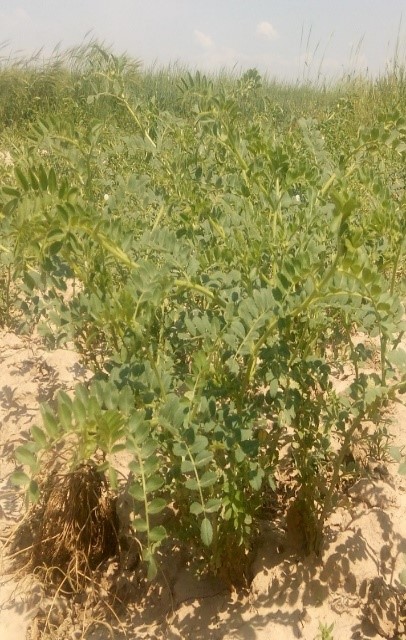
- 📍 Kamashi (Uzbekistan)
- 🗓 2026-06-04
- 📷 Ram Sharma
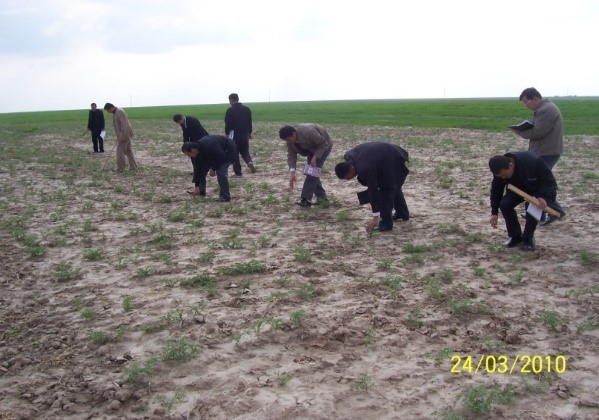
- 📍 Kamashi (Uzbekistan)
- 📷 Ram Sharma