
Terraces with improved seed and fertilizer application
Type: Technologies
Creation: 2016-09-27 16:45 Updated: 2019-02-15 09:58
Compilers: Roziya Kirgizbekova
Reviewers: Rima Mekdaschi Studer, Alexandra Gavilano
Country/ region/ locations where the Technology has been applied and which are covered by this assessment
- Country: Afghanistan
- Region/ State/ Province: Takhar Province, Rustaq District
- Further specification of location (e.g. municipality, town, etc.), if relevant: Chokar Watershed: Sari Joy (upper watershed), Jawaz Khana (middle watershed), Dashti Mirzai (lower watershed)
- Map: View Map
Description of the SLM Technology
Short description of the Technology
Terraces are established on mountain slopes used mainly for cropping wheat, with the purpose of soil protection from erosion, preserving runoff, sediments and nutrients on-site. Improved seeds and fertilizer are applied on the terraces for increasing crop yield, but also vegetation cover and biomass production, and thus prevent further land degradation.
Detailed description of the Technology
Project supported implementation of terraces with application of improved seeds and fertilizer has taken place in the villages Sari Joy, Jawaz Khana and Dashti Mirzai, located in Chokar watershed of Rustaq District in Northern Afghanistan. The Chokar watershed is a mountainous area situated between 600 - 2,500 m above sea level. The climate is semi-arid with harsh and cold weather in winter and hot and dry summers. The annual precipitation in average years is 580mm. Land degradation affects all forms of land use and includes low vegetation cover, heavy top soil erosion from water, and poor soil fertility. Unsustainable agricultural practices, over-exploitation and high pressure on the natural resources are adversely impacting on the socio-economic well-being of local communities as well as contributing to the risk for being adversely affected by drought as well as landslides and flash floods triggered by heavy rainfall.
The data used for the documentation of the technology is based on field research conducted in Chokar watershed, namely in the villages: Sari Joy, Jawaz Khana and Dashti Mirzai. These villages represent the upper, the middle and the lower zone of Chokar watershed, respectively. They differ considerably in access to services and infrastructure, but in general are poorly served. The communities depend mainly on land resources for sustaining their livelihoods. In a good year with high yields, wheat-self-sufficiency lasts about 5 months.
Since 2012 the Livelihood Improvement Project Takhar (LIPT) implemented by Terre des hommes (Tdh) Switzerland has initiated a range of NRM interventions. The project introduced terraces as sustainable land management practices on private plots, situated on rolling (11-15%) and hilly (16-30%) slopes to protect the land from soil erosion and prevent the loss of water and fertile topsoil, seeds and fertilizers. The average plot size for terrace implementation is 2 Jerib (0.4 hectares) with contour strips of 40m x 4m. The height of the risers is 1m-1,5 m. Terrace benches are built along the contour by moving the soil above the bench downwards. The leveled benches of the terrace are cultivated with wheat. The risers of the terrace are mostly used for growing fodder crops, mostly alfalfa, which also helps to stabilize the terrace. If medicinal herbs (ferula) are included they are cultivated along the bench contours .
Maintenance activities include small repair work on the riser by adding some amount of soil and re-sowing of alfalfa seeds on those spots.
The terraces allow application of improved seeds and fertilizers without them being washed off. The land-users report noticeable increase of wheat yield from the terraced plot with application of improved seeds and fertilizer compared to the non-terraced plot. An average plot of 0.2 ha on non-terraced hilly cropland used to give about 70 kg of wheat (350kg/ha). On terraces the yield has increased/ doubled to 140 kg on the same plot area (700kg/ha). The expectations regarding terraces remain high as over the time the land user hope their land will become more stable and improved soil moisture and fertility will have positive impact on the productivity as well. However, so far no cost-benefit assessment has been conducted allowing attribution of individual measure to the wheat increase.
Many land users are interested in the terrace technology due to a number of environmental and economic benefits expected, however the costs for building the terrace are considered high by an average local land user. They have to rely on external support in order to have sufficient resources for implementation. Women considered an advantage that during the establishment phase, men were paid by the project to work on their own land (or other villagers land) when building the terraces. Thus, there was no need for men to go for seasonal labour migration and they stayed at home.
Photos of the Technology
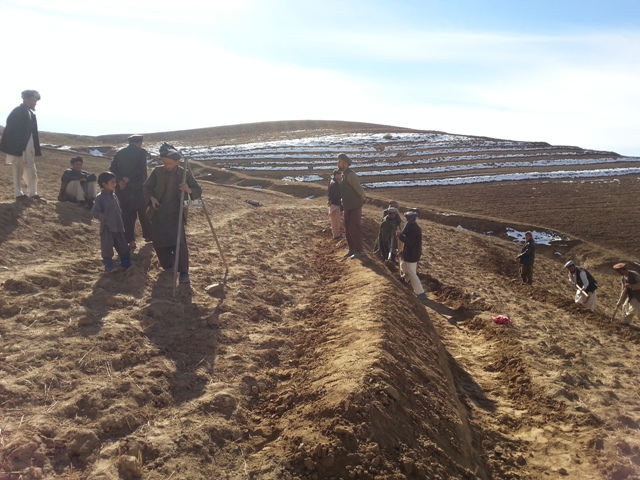
- 📍 Sari Joy, Rustaq, upper zone of Chokar watershed
- 📷 Mia Jan Maroofi
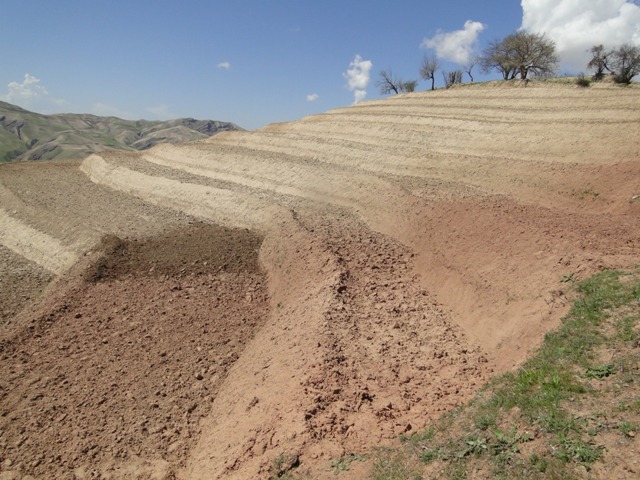
- 📍 Sari Joy, Rustaq, upper zone of Chokar watershed
- 📷 Mia Jan Maroofi
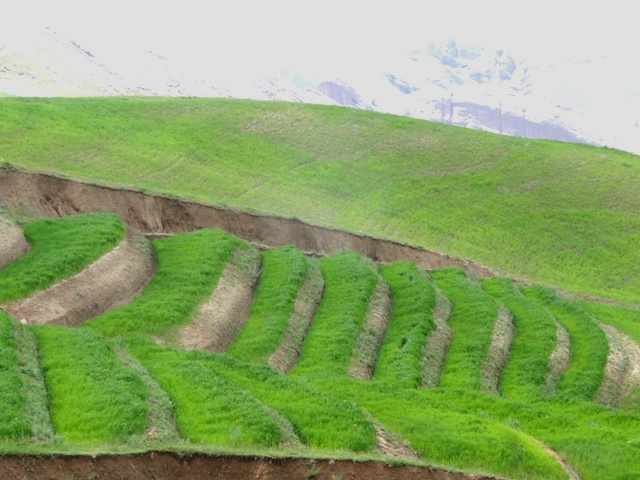
- 📍 Sari Joy, Rustaq, upper zone of Chokar watershed
- 📷 Mia Jan Maroofi