
Fundamental Improvement of Low-Productivity Pastures through Strip Planting of Perennial Drought-Resistant Grasses in the Foothill Semi-Desert Zone of Southeastern Kazakhstan
Type: Technologies
Creation: 2022-11-17 05:54 Updated: 2025-08-27 07:45
Compilers: Kulyash Iskandarova
Reviewers: Olga Andreeva, Rima Mekdaschi Studer
Country/ region/ locations where the Technology has been applied and which are covered by this assessment
- Country: Kazakhstan
- Region/ State/ Province: Aksu district, Zhetysu region
- Further specification of location (e.g. municipality, town, etc.), if relevant: Kapal village
- Map: View Map
Description of the SLM Technology
Short description of the Technology
Radical improvement of low-yield pastures by strip placement of perennial drought-resistant grasses in the conditions of the foothill-semi-desert zone of south-eastern Kazakhstan
Detailed description of the Technology
Livestock farming is one of the main economic activities in the Kapal rural district of Aksu District, Zhetysu Region, Kazakhstan. The natural pastures are characterized by diverse vegetation, including feather grass (Stipa), fescue (Festuca), izen (Kochia prostrata), teresken (Krascheninnikovia ceratoides), sainfoin (Onobrychis), wormwood (Artemisia), sedge (Carex), brome (Bromus), and bluegrass (Poa). However, the pastures are heavily grazed without adherence to grazing regimes or stocking norms, which leads to their degradation. The low productivity of the rangelands fails to meet the forage needs of the existing livestock population.
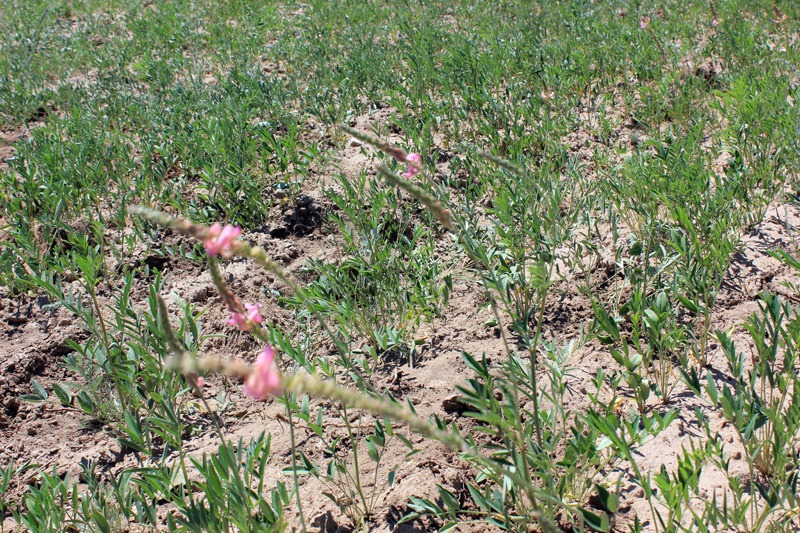
To restore degraded natural pastures near the village of Kapal, the FAO/GEF project “Integrated Natural Resources Management in Drought-Prone and Salt-Affected Agricultural Production Landscapes in Central Asia and Turkey” (CACILM-2) introduced a technology aimed at the accelerated improvement of low-productivity pastures through the sowing of perennial legumes (sainfoin) and grasses (crested wheatgrass).
1. Natural and Socio-Economic Conditions
The project site (Farmer Cooperative “Bereke”) is located on a plateau at the foot of the Kapal Range of the Dzungarian Alatau at an elevation of 975 m above sea level, 81 km northeast of Taldykorgan. The average annual precipitation is 300–350 mm. The mean temperature in January is –15 °C and in July +24 °C.
The area lies in a foothill semi-desert arid zone with natural grass–wormwood–forb vegetation and chestnut soils. The site borders mountain slopes with a high content of stones and boulders.
Kapal village is the administrative center of the Kapal rural district of Aksu District, with a population of 3,660 people in 863 households. The main livelihoods are livestock husbandry and crop farming. Land use covers 36,716 ha, including 6,605 ha of cropland, 4,827 ha of pastures, and 2,233 ha of hayfields. Cultivated crops include wheat, barley, and perennial grasses. Livestock numbers include 23,492 sheep, 3,745 goats, 3,300 horses, and 6,561 cattle, of which 2,751 are dairy cows.
2. Key Characteristics and Technical Features of the Technology
This technology is relatively low-cost: sainfoin sowing is required only once every five years, while crested wheatgrass maintains productivity for 20–30 years. Its application increases pasture yields and establishes a sustainable forage base for livestock.
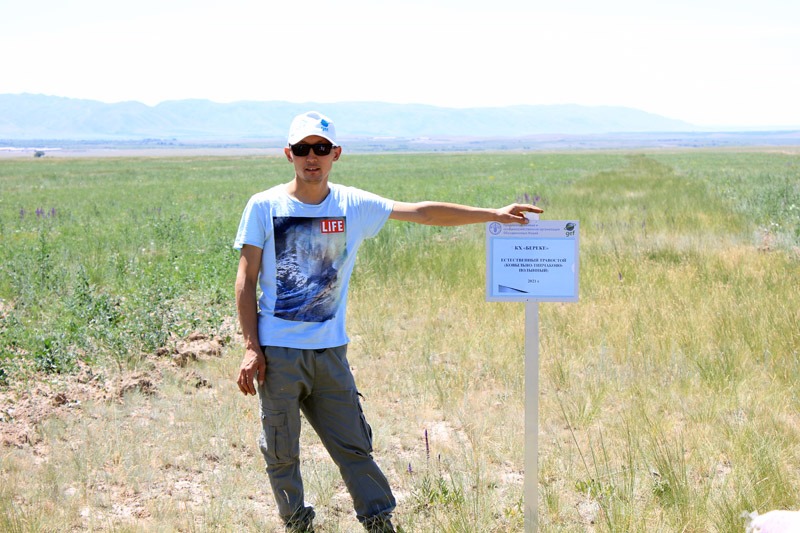
The technology was implemented on 30 ha of land adjacent to Kapal village (Farmer Cooperative “Bereke”). It was introduced within the framework of the “strip-seeding improvement” approach.
3. Objectives and Functions of the Technology
Accelerated improvement of low-productivity pastures through strip sowing of perennial drought-resistant forage crops while maintaining part of the natural vegetation cover.
4. Main Activities and Resources Required
Geobotanical or field survey to assess land suitability (topsoil depth at least 30 cm);
Division of the land into strips: 30 m (perennial crops) alternating with 15 m (natural vegetation);
On strips designated for crops: moldboard plowing (PLN-3.5), disking to 5–10 cm (LDG-5), harrowing (Zig-Zag tooth harrow), and rolling;
Sowing with a grain drill (SZT-3.6), followed by rolling (ZKKSh-6 ring roller). Sowing method: continuous row with 15 cm spacing. Seeding rates: crested wheatgrass 16–18 kg/ha (depth 1.5–2 cm); sainfoin 70–80 kg/ha (depth 4–5 cm).
During the first two years, while plants are establishing, the land is not used for grazing. From the second year, mowing for hay is possible.
If needed, fencing is installed to protect young plants from grazing.
Costs of implementation:
The establishment cost of 1 ha of strip-planted pastures with sainfoin and crested wheatgrass, including soil preparation and seed sowing, is 60,320 KZT (≈ 140.5 USD).
Maintenance costs:
Annually: early spring harrowing to conserve soil moisture (2,970 KZT/ha).
Every 5 years: reseeding sainfoin at a cost of 48,320 KZT/ha (≈ 112.6 USD/ha), covering seed purchase, labor, machinery, fuel, and all necessary agrotechnical measures (plowing, disking, harrowing, rolling, sowing).
5. Advantages and Impacts of the Technology
This technology is recommended for the foothill semi-desert zones of Kazakhstan. Compared to monoculture seeded pastures or degraded natural rangelands, it provides several advantages:
Preserved strips of natural vegetation prevent wind erosion on seeded areas and reduce further degradation;
Strip planting of perennial grasses and natural vegetation provides livestock with more diverse and nutritious forage than monoculture pastures;
Sowing perennial drought-resistant species more than doubles pasture productivity compared to natural pastures;
Crested wheatgrass maintains productivity for 20–30 years with proper management (spring harrowing, rotational grazing), contributing to soil humus and topsoil accumulation;
Sainfoin enriches soil fertility by fixing atmospheric nitrogen, thus improving nitrogen content in the soil;
Both sainfoin and crested wheatgrass are more drought-resistant than most other forage crops.
6. Farmers’ Perceptions of the Technology
Farmers reported the following positive outcomes:
More efficient use of land resources;
Guaranteed forage harvests even in dry years;
Improved forage nutritional quality;
Reduced production costs for livestock products (e.g., beef).
Photos of the Technology

- 📍 Kapal village, Aksu district, Zhetysu region, Kazakhstan
- 🗓 2022-03-06
- 📷 Almas Tasbatyrov
- 📍 Kapal village, Aksu district, Zhetysu region, Kazakhstan
- 🗓 2021-03-07
- 📷 Gauhar Dzheksembieva
- 📍 Kapal village, Aksu district, Zhetysu region, Kazakhstan
- 🗓 2021-03-07
- 📷 Gauhar Dzheksembieva