
Community Based Soil Rehabilitation for Grassland on Common Lands after Eradication of the Invasive Lantana Camara
Type: Technologies
Creation: 2023-03-15 18:11 Updated: 2024-05-30 09:19
Compilers: Santosh Gupta
Reviewers: Udo Höggel, Joana Eichenberger, Sally Bunning, Rima Mekdaschi Studer
Country/ region/ locations where the Technology has been applied and which are covered by this assessment
- Country: India
- Region/ State/ Province: Madhya Pradesh
- Further specification of location (e.g. municipality, town, etc.), if relevant: Village: Changaniya, Block- Bichhiya, Mandla
- Map: View Map
Description of the SLM Technology
Short description of the Technology
Community-based soil rehabilitation by eradicating the invasive plant Lantana Camara using the 'cut rootstock' method (refer to WOCAT technology 6660) is an effective, cost-efficient, and sustainable approach to restoring grasslands on common lands in the Mandla District of Madhya Pradesh. The three-tier institutional structure used in this eradication process involved the formation of informal women groups at the hamlet level (village organisational structure), the Village Environment Committee (VEC) at the village level, and an Executive Committee at the cluster level (higher organisational structure) so to ensure community involvement and ownership.
Detailed description of the Technology
Community-based soil rehabilitation after the eradication of the invasive plant species, Lantana Camara, is an effective technique for restoring grasslands on common lands that had earlier been invaded by this species. The invasion of Lantana Camara can have significant negative impacts on the ecosystem, reducing the diversity of plant life and disrupting the local communities' use of common lands for grazing, for agriculture, and for collecting non-timber forest products.
To address these issues, a three-tier institutional structure is being used by the project-implementing organization Foundation for Ecological Security (FES). This structure includes the formation of informal women groups at the hamlet level, the Village Environment Committee (VEC) at the village level, and an executive committee at the cluster level. The VEC prepares proposals on common issues and plans with budgets that are presented to the executive committee, which is made up of a mix of individuals, with 50% of the seats reserved for women.
The first step in the process is for the village executive committee to take the Gram Sabha (Village Governing Body) into confidence and prepare bylaws for the restoration and conservation of the Lantana-eradicated site. These bylaws are regularly discussed in the village institution meeting to refresh the memory of the community and different stakeholders on how to properly conserve the site. Local resource persons facilitate the implementation of work.
One of the major works undertaken by these communities in the Mandla District is the soil rehabilitation from Lantana Camara for grassland restoration on common lands. The uprooting of Lantana is a tricky process, and improper methods can result in an even more forceful recurrence of the species. Therefore, the "cut rootstock" method is used, which involves cutting the root of the plant three inches below the ground and lifting the bush upside down to prevent it from gaining ground. This method is done between July and September before fruiting to avoid seed fall, which can cause recurrence for up to three years, also this is the time when the soil has enough moisture thus softness to uproot the Lantana plants.
The Cut Rootstock (CRS) method to control the spread of Lantana Camara is cost-effective and sustainable as it does not require the use of chemical herbicides or heavy machinery. In addition to using the CRS method, perching trees are located, and saplings are removed from under their canopies and along the nearby surface runoff zone. Regular monitoring and follow-up actions may be necessary to ensure the long-term success of this method in controlling the spread of Lantana Camara.
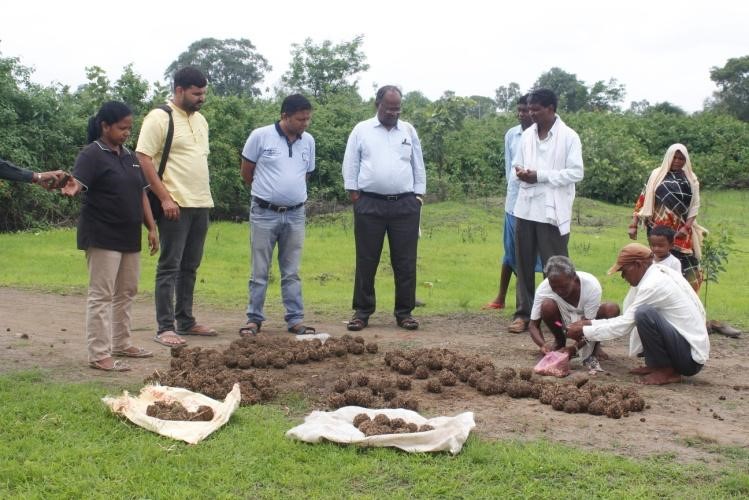
To prevent a recurrence, measures such as mopping for three years continuously, planting and seed sowing in areas where rootstocks seem to be less, and grass seed sowing are executed. The community institution ensures the collection of indigenous grass species, which are made into seed balls and sown before the advent of monsoon. These grass seeds germinate and grow in the rainy season, reducing the suitable environment for Lantana seed germination. Revegetation measures involve selecting and planting grazing hardy, fire hardy, and water hardy tree species such as bamboo, Khameer, Java Plum, Karanj (Pongame oil tree), Aonla, Harra, and other non-timber forest product-producing tree species. These plants are selected to create a three-tiered forest and sustainably provide food, fuel wood, and fodder. Once established, they do not allow Lantana to grow.
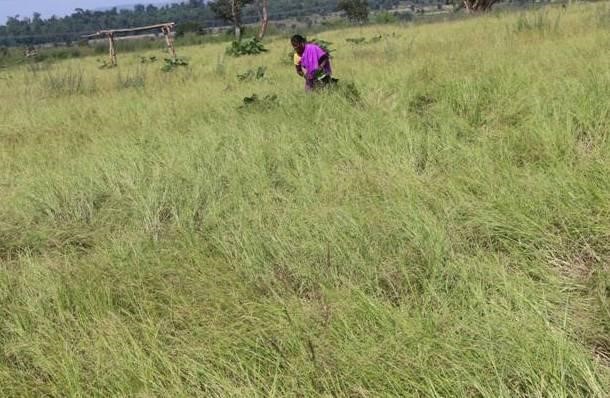
Biomass assessment is undertaken every year to assess the improvement in the status of the biomass in the plot, and the findings are shared with the community to motivate them to follow the rules and regulations formulated by the village institution. Cut and carry practices are allowed from the second year, but open grazing is prohibited, and Lantana eradication from nearby areas is required while cutting the grass. This helps to bring Lantana under control while sustainably utilizing the grass resources.
This initiative has ensured access to common lands for the local communities, access to fodder and green grass for livestock and the emergence of biodiversity in the area. This initiative is well recognised by Government institutions and policy makers.
Photos of the Technology
- 📍 Village: Changaniya, Block- Bichhiya, Mandla
- 📍 Village: Changaniya, Block- Bichhiya, Mandla
- 📍 Village: Changaniya, Block- Bichhiya, Mandla