Contour hedgerows of alfalfa in annual cropland
Type: Technologies
Creation: 2016-10-27 21:36 Updated: 2021-11-02 12:40
Compilers: Bettina Wolfgramm
Reviewers: William Critchley
Country/ region/ locations where the Technology has been applied and which are covered by this assessment
- Country: Afghanistan
- Region/ State/ Province: Takhar Province, Rustaq District
- Further specification of location (e.g. municipality, town, etc.), if relevant: Sari Joy and Jawaz Khana Villages
- Map: View Map
Description of the SLM Technology
Short description of the Technology
Hedgerows are vegetative strips of perennial grasses, shrubs or legumes - such as alfalfa - located along contours across a slope. These vegetative strips form a barrier to halt soil erosion and improve soil fertility. Hedgerows of alfalfa also provide quality animal fodder for a period of 5-10 years.
Detailed description of the Technology
Project supported implementation of hedgerows has taken place in the villages of Sari Joy and Jawaz Khana, located in Chokar watershed of Rustaq District in Northern Afghanistan. The Chokar watershed is a mountainous area situated between 600 m and 2,500 m above sea level. The climate is semi-arid with harsh and cold weather in winter and hot and dry summers. The annual precipitation in average years is 580mm. Land degradation affects all forms of land use and includes sparse vegetation cover, severe top soil erosion through rainfall runoff, and poor soil fertility. Unsustainable agricultural practices, and over-exploitation of the natural resources are adversely impacting the socio-economic well-being of local communities, as well as contributing to the risk of being adversely affected by drought, landslides and flash foods triggered by heavy rainfall. The data used for the documentation of the technology are based on field research conducted in Chokar watershed, namely in the villages of Sari Joy and Jawaz Khana. These villages represent the upper and the middle zone of Chokar watershed, respectively. They differ considerably in access to services and infrastructure, but in general are poorly served. The communities depend on land resources for sustaining their livelihoods. In a good year with high yields, wheat self-sufficiency lasts about 5 months. The three villages are home to ethnic Qarluq communities. Since 2012 the Livelihood Improvement Project Takhar (LIPT) implemented by Terre des hommes (Tdh) Switzerland has initiated a range of NRM interventions.
Hedgerows are vegetative strips, planted as contour barriers. In this case they are composed of the perennial legume alfalfa (sometime called lucerne: Medicago sativa), Using an A-frame, contours are defined and demarcated horizontally across the hillside. The distance between the contours depends on the slope gradient. For moderate slopes above 6%, and hilly slopes below 30%, the distance between the contours is 4-5 meters. Using such contouring measurements, a plot area of 0.2 ha is divided into 8 hedgerows along the slope. Once all the contours are established, the topsoil is levelled using a shovel. On each marked contour a soil ridge is created, some 10-20 cm high. On these ridges alfalfa seeds are sown to form the vegetative hedgerow. This stops soil wash, and prevents most of the rainfall runoff. The area between the grass strips is cropped with wheat. The hedgerows are protected for one year, to allow the alfalfa to become established.
Hedgerows were introduced in the local villages to promote low-cost land management practices, which are sustainable and well adapted to the local environmental conditions. Apart from reducing soil erosion, this new practice takes into account the needs of local people to improve soil fertility and increase agricultural yields. Local land users were trained to establish hedgerows on their own land using low amount of inputs. They were given the technical knowledge required. Over the past four years of implementation the land users report noticeable improvements on their plots. The soil is protected from erosion, and the households harvest wheat for the family and alfalfa for their livestock.
One of the key benefits of the technology is that it does not require many or costly inputs and it is relatively easy to establish without technical support. Improved production and availability of alfalfa is a primary benefit from the land users' point of view. They can harvest fodder from the plot for up to 10 years without reseeding.
Hedgerows are among the least labour-intensive SLM practices and thereby do not have a significant influence on the daily household workload of local women. This feature of the technology is perceived as its strength by many female family members.
Photos of the Technology
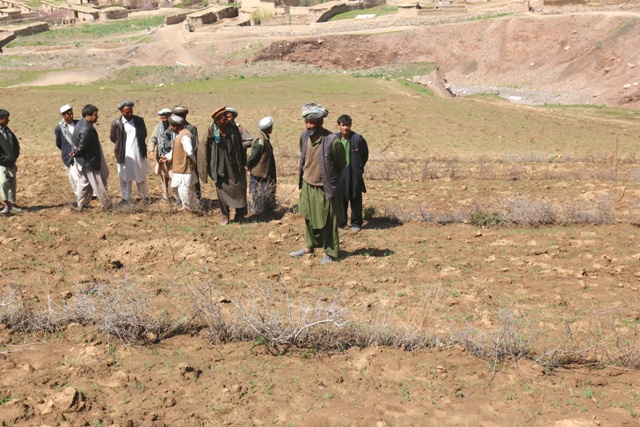
- 📍 Sari Joy, Rustaq
- 📷 Mia Jan Maroofi
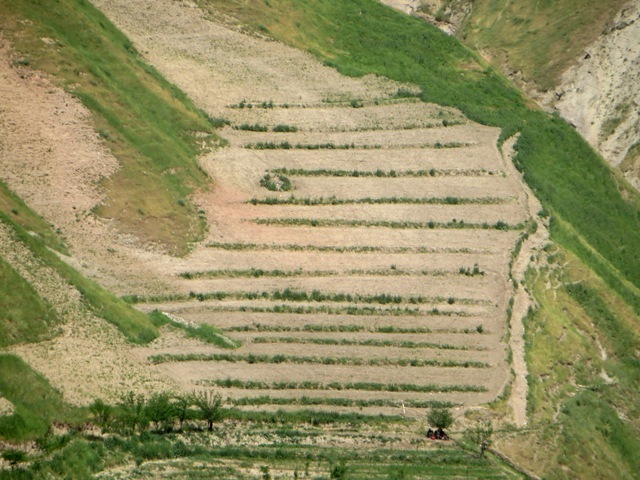
- 📍 Sari Joy, Rustaq
- 📷 Mia Jan Maroofi