
Contour Stone Bunds
Type: Technologies
Creation: 2023-08-19 14:14 Updated: 2024-06-04 14:48
Compilers: Nima Dolma Tamang
Reviewers: William Critchley, Rima Mekdaschi Studer, Joana Eichenberger
Country/ region/ locations where the Technology has been applied and which are covered by this assessment
- Country: Bhutan
- Region/ State/ Province: Lhuentse Dzongkhag
- Further specification of location (e.g. municipality, town, etc.), if relevant: Zangkhar Village, Yabi-Zangkhar Chiwog, Jaray Gewog
- Map: View Map
Description of the SLM Technology
Short description of the Technology
Contour stone bunding on sloping agricultural lands reduces soil erosion and conserves soil moisture in order to retain soil productivity. It is promoted /recommended on slopes where there is adequate surface stone.
Detailed description of the Technology
Contour stone bunds are small walls of stone that are laid out along the contour line to help reduce soil erosion, conserve soil moisture, increase soil fertility, to ease workability, increase cropping area, and ultimately ensure sustainable use of lands for enhanced food and nutrition security. This practice is recommended in fields that have plenty of surface stones (> 20%). Construction of contour stone bunds not only helps to get rid of the excess surface stones and gravel but also reduces the slope gradient through formation of partial terraces over a few years.
The stone bund is not new to Bhutan, being a mountainous country, forefathers used the technique to remove stones from the field and stabilise the land for agricultural purposes. Therefore, there were some traditional stone lines constructed in the study area.
Constructing stone bund is labour intensive, therefore land users resort to a labour sharing approach where all the land users from the community come together and work on a rotational basis until every household in the community has established stone bunds.
The major activities and inputs required to establish the contour stone bund includes sensitization of beneficiaries, followed by SLM action planning, and hands-on-training. Field implementation follows this sequence: (a) determination of intervals between stone bunds, (b) demarcation of contour lines using an ‘A’ frame, (c) digging a trench of 0.1 - 0.2 m deep and 0.5 m wide to establish a foundation along the contour lines, and (d) constructing stone lines along the trenches with the larger stones at the base to set a sound foundation. A typical stone wall is 0.3 m high (1 ft) and 0.3 - 0.5 m wide, but this depends on the slope and availability of stones in the field. Contour stone bunds are commonly spaced 6 metres apart on slopes of 60%. In some cases, the fodder grass slips are also planted at the base of the stone bund for better stabilization of the bunds and fodder availability.
The major drawbacks of this SLM technology according to respondents are (a) labour demanding, (b) no immediate return, and (c) the space between piled stones harbours rodents leading to crop damage.
Photos of the Technology
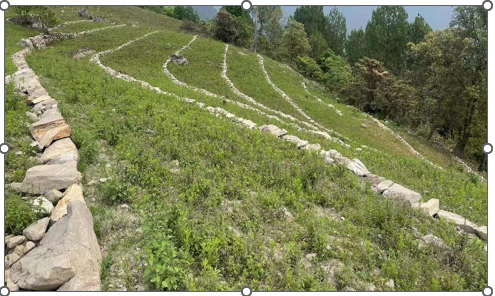
- 📍 Zangkhar Village, Yabi-Zangkhar Chiwog, Jarey Gewog, Lhuentse Dzongkhag
- 📷 Haka Drukpa
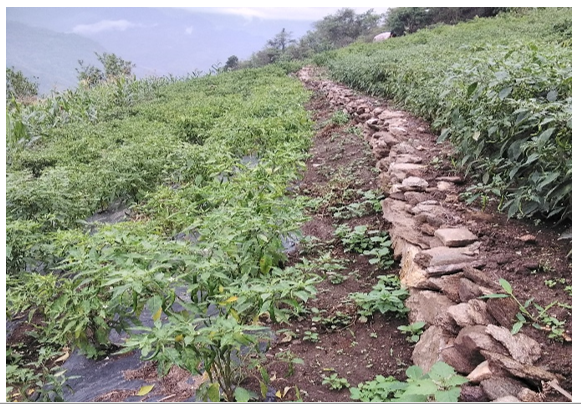
- 📍 Zangkhar Village, Yabi-Zangkhar Chiwog, Jarey Gewog, Lhuntse Dzongkhag
- 📷 Haka Drukpa