
Gradoni Orchard Terraces
Type: Technologies
Creation: 2025-05-23 13:40 Updated: 2025-10-08 16:06
Compilers: Joren Verbist
Reviewers: William Critchley, Rima Mekdaschi Studer
Country/ region/ locations where the Technology has been applied and which are covered by this assessment
- Country: Uzbekistan
- Region/ State/ Province: Qashakadarya province
- Further specification of location (e.g. municipality, town, etc.), if relevant: 8°43'14.26"N, 66°41'51.87"E
- Map: View Map
Description of the SLM Technology
Short description of the Technology
Gradoni orchard terraces are intermittent strips of contour-based structures separated by catchments of about 10 metres. They are designed to capture and hold rainwater, reduce erosion, and improve conditions for the cultivation (in this case) of almond and pistachio trees, thereby enhancing land productivity and climate resilience in dryland areas.
Detailed description of the Technology
Qashqadaryo Province in southern Uzbekistan experiences a hot, dry summer and a mild winter. Combined with unsustainable land management practices, climatic stresses have exacerbated land degradation and made local livelihoods increasingly vulnerable.
As part of the Food Systems, Land Use and Restoration (FOLUR) project, the International Center for Agricultural Research in the Dry Areas (ICARDA) designed and tested rainwater harvesting (RWH) structures to combat land degradation and enhance rural livelihoods. These RWH structures support vegetation growth, reduce surface runoff, prevent erosion, and restore soil health—thereby reversing degradation and improving agricultural productivity.
The intervention site, covering approximately 1.6 hectares, is characterized by shallow clay soils (5–25 cm deep).
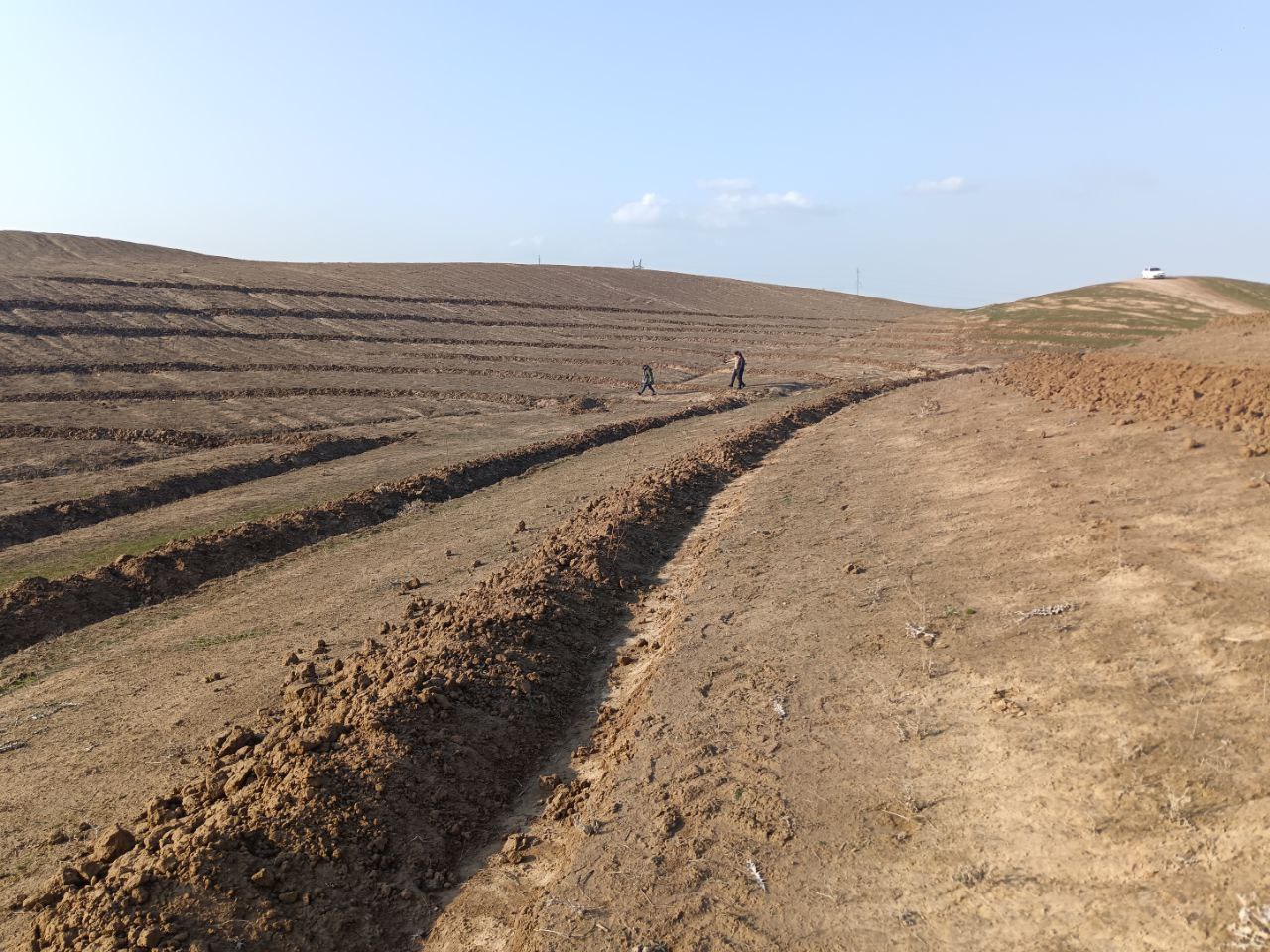
Gradoni orchard terraces (“intermittent terraces” or “step terraces”) were used. These small contour-based earth structures are separated by catchments of about 10 metres. They are designed to capture and hold rainwater, reduce erosion, and improve conditions for the cultivation – in this case of almond and pistachio.
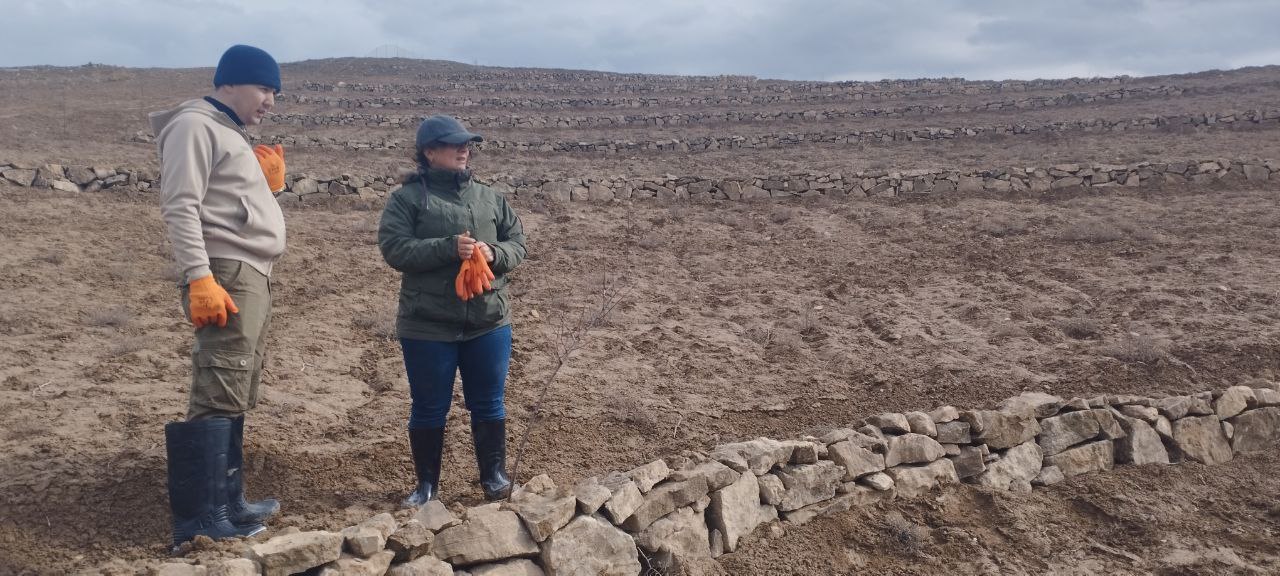
Two variations were implemented depending on the slope gradient: one with stone-reinforced risers on steep slopes (20–25%), and the other with earth risers on moderate slopes (12–19%). The terraces are sited about 10 meters apart on contour lines, and the terrace beds are only 1-1.5 metres wide and the risers 0.25-0.5 metres high. Along each back-sloping terrace bed, 5 metres spacing between trees was considered optimal.
Following site assessment, data collection, and detailed design calculations, implementation commenced. Although a grader was initially preferred for terrace construction, an older local tractor was used due to its better manoeuvrability on the steep terrain. The tractor ploughed the land using a two-mouldboard plough, after which manual labour, guided by technical experts, shaped the terraces. To accommodate natural contour variability, the terraces were not continuous – but gaps were left between them.
During a week of implementation, 25 Gradoni terraces were constructed, of which eight were stone-reinforced. Around 340 almond and pistachio trees were planted. Two workers had spent two days marking contour lines, while ten others worked for four days to finalize the terraces after the tractor had loosened the soil. The estimated lifespan of the terraces is around 20 years without maintenance, with the stone-reinforced ones expected to last even longer.
Land users expressed optimism about the prospect of improved incomes from almond and pistachio yields, especially considering the previously low or non-existent production due to severe land degradation and lack of water.
Maintenance requirements are expected to be minimal. Experts highlighted the terraces' role in capturing and retaining rainwater, which supports vegetation regeneration and contributes significantly to reversing and preventing further land degradation. By improving water availability, the intervention strengthens the community’s ability to withstand droughts, thereby securing income in the face of climate variability. The introduction of pistachio and almond cultivation provides a new and valuable source of income for local land users. These tree crops are well-suited to the arid environment and are inherently drought-resilient, making them an ideal choice for sustaining agricultural productivity under increasingly dry conditions.
Acknowledgement: This SLM was introduced by ICARDA in the framework of Food Systems, Land Use and Restoration Impact Program (FOLUR) in Uzbekistan (GCP/UZB/010/GFF), implemented by FAO with funding from the Global Environment Facility (GEF)
Photos of the Technology
- 📍 Uzbekistan
- 🗓 2026-06-04
- 📷 ICARDA
- 📍 Uzbekistan
- 🗓 2026-06-04
- 📷 ICARDA